
Choosing the Right Propane Tank Size for Your BTU Load
Blog
Read more

Safe propane for your business

National delivery, local service

Tailored pricing to your business needs
When the power goes out, businesses, facilities, and critical infrastructure rely on backup generators to keep operations running. But before investing in a generator system, one important question comes up:
Which fuel should you choose – propane or diesel?
Diesel generators have long dominated the commercial backup power market, but propane generators are gaining traction as organizations look for cleaner, lower-maintenance, and more reliable energy solutions. Each fuel type has advantages depending on your priorities, including cost, runtime, emissions, and fuel storage.
In this guide, we break down the pros, cons, costs, and performance of propane vs. diesel generators so you can determine which option best fits your operation.
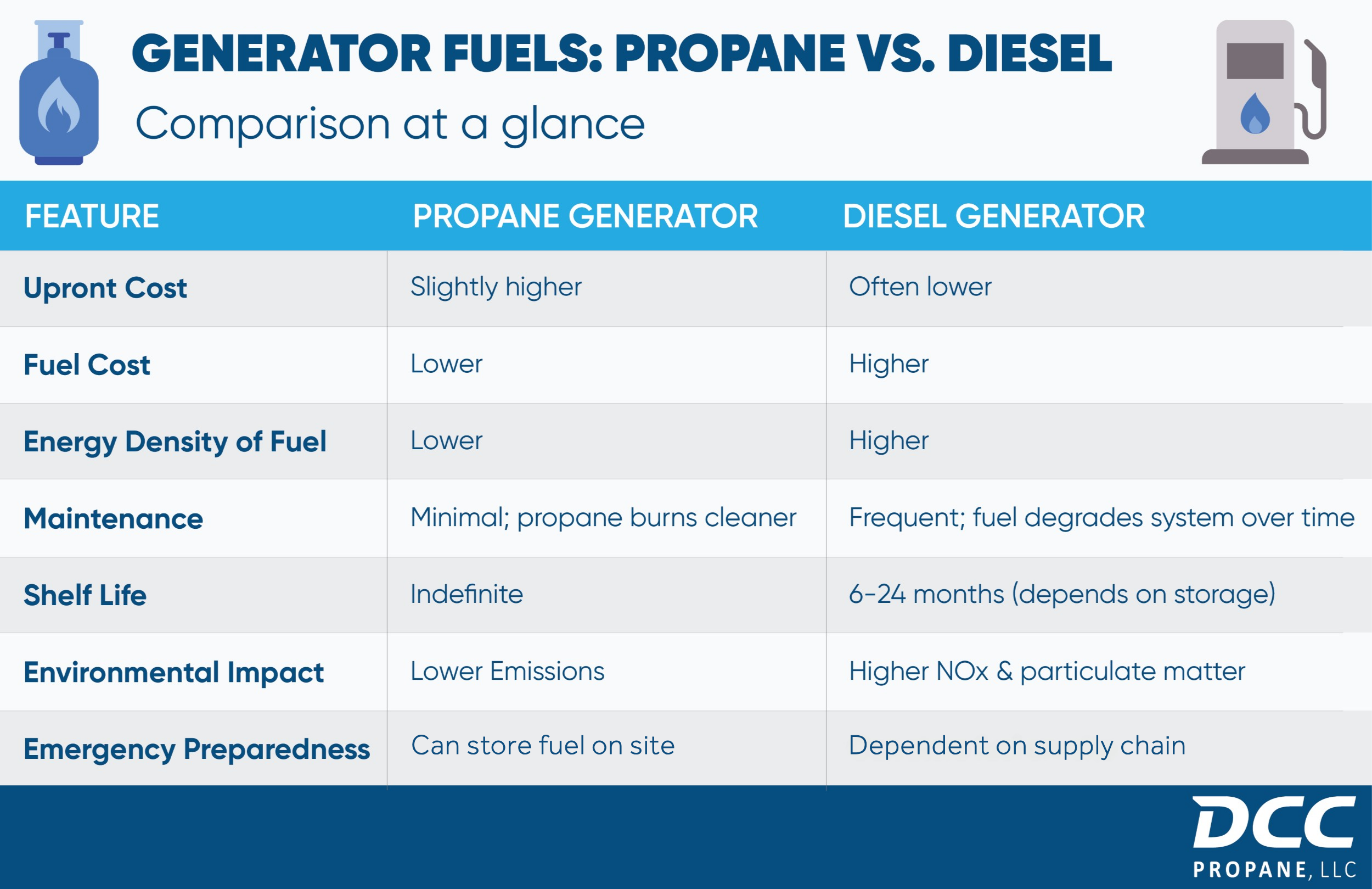
Diesel generators typically come with a lower upfront equipment cost compared with propane generators of similar size. Diesel engines are widely used for heavy-duty applications and have been the traditional choice for standby power in hospitals, data centers, and industrial facilities.
However, fuel cost and long-term operational and maintenance expenses change the equation.
Diesel prices can fluctuate significantly due to global oil markets, refining capacity, and transportation costs. In contrast, propane pricing is known to be more stable and less volatile, particularly for businesses supplied through bulk propane contracts (U.S. Energy Information Administration, 2024).
From a pure energy standpoint, diesel contains approximately 137,000 BTUs per gallon, while propane contains roughly 91,500 BTUs per gallon (U.S. Energy Information Administration). This means diesel has higher energy density.
However, several operational costs narrow the gap:
• Diesel generators require more frequent and a greater level of maintenance
• Diesel fuel degrades over time and must be replaced or treated, whereas propane does not deplete or expire
• Propane systems require lower service and fuel management costs
Bottom line:
While diesel generators may have a lower upfront cost, propane generators often prove more cost-effective over time thanks to stable, predictable fuel pricing and reduced long-term maintenance expenses.
Backup generators are often purchased for one reason: reliability during emergencies.
Diesel generators can run for long periods as long as fuel is available, which makes them popular for continuous-duty applications. However, diesel systems face a significant limitation during extended outages: fuel degradation and storage management.
Diesel fuel can begin to degrade within 6–12 months, leading to issues such as microbial growth, sludge formation, and clogged filters if not properly treated (National Renewable Energy Laboratory).
Propane offers a key advantage here.
Propane is stored as a pressurized liquid in sealed tanks and does not degrade over time. It has an indefinite shelf life, meaning the fuel stored today will perform the same years later (Propane Education & Research Council).
This makes propane particularly valuable for standby systems that may sit unused for long periods but must operate flawlessly when needed.
Key takeaway:
For long-term fuel storage and emergency preparedness, propane generators offer greater reliability and fuel stability.
Generator maintenance is another area where the fuel type makes a major difference.
Diesel engines rely on high compression ignition, which creates significant internal stress and requires robust engine components. While diesel engines are durable, they typically endure inconvenient and costly expenses like:
• Regular oil changes
• Fuel polishing or stabilizers
• Filter replacements
• Fuel system maintenance
Diesel systems can also develop carbon buildup and injector fouling, particularly if they run intermittently rather than continuously.
Propane generators operate differently. Propane is a gaseous fuel, which results in a cleaner combustion process.
Compared with diesel engines, propane engines typically produce:
• Less carbon buildup
• Fewer deposits inside the engine
• Reduced contamination of engine oil
According to the Propane Education & Research Council, propane engines can experience less wear and longer service intervals because of their cleaner combustion characteristics.
Result:
Propane generators generally require less frequent maintenance and may experience longer engine life, especially in standby applications where generators run periodically rather than continuously.
As businesses increasingly focus on sustainability and emissions reduction, generator fuel choices are becoming more important.
Diesel engines are higher polluting and produce significant emissions, including:
• Nitrogen oxides (NOx)
• Particulate matter (PM)
• Carbon monoxide
• Carbon dioxide
While modern diesel generators use emission control technologies, they still produce higher levels of pollutants than propane systems.
Propane is classified by the U.S. Environmental Protection Agency (EPA) as a clean alternative fuel under the Clean Air Act.
Compared with diesel, propane typically produces:
• Up to 20% fewer greenhouse gas emissions
• Significantly lower particulate matter emissions
• Lower nitrogen oxide emissions (EPA Alternative Fuels Data Center)
Because propane combustion produces very little particulate matter, it is often preferred in environments where air quality and regulatory compliance are important.
Winner for sustainability goals:
Propane generators offer cleaner emissions and improved air quality performance, enabling businesses to achieve carbon reduction targets.
Fuel storage is a critical consideration for generator installations.
Diesel Storage
Diesel must be stored in above-ground or underground tanks, and the fuel can degrade or become contaminated by water or microbes. Facilities often need fuel management programs to monitor fuel quality and prevent operational issues.
Diesel spills also present environmental risks and may require containment systems depending on storage volume.
Propane Storage
Propane is stored in above-ground or underground pressurized tanks designed for long-term outdoor storage. The fuel is stable and does not degrade, eliminating the need for stabilizers or polishing.
Propane tanks are also equipped with safety valves and pressure relief systems to prevent over-pressurization.
Another advantage is that propane is non-toxic and does not contaminate soil or groundwater if released (Propane Education & Research Council).
Safety takeaway:
Propane offers simpler long-term storage and fewer environmental risks related to spills or contamination.
During large-scale power outages or natural disasters, fuel supply chains can be disrupted.
Diesel fuel is often distributed through transportation networks and retail fueling stations. If those systems lose power or become overwhelmed by demand, diesel availability can be limited.
Propane distribution works differently.
Because propane is delivered directly to bulk storage tanks, businesses can maintain on-site fuel reserves that are independent of retail infrastructure. Many propane suppliers also prioritize deliveries for critical facilities during emergencies.
This makes propane particularly useful for:
• Hospitals
• Data centers
• Telecommunications infrastructure
• Any commercial facilities requiring uninterrupted operations
Preparedness advantage:
Propane allows businesses to store fuel on-site for years without degradation, improving resilience during extended outages.
Choose Propane If:
• You want lower maintenance and cleaner combustion
• Long-term fuel storage and reliability are important
• You want to reduce emissions and environmental impact
• Your facility values energy reliability independence during outages
For many organizations, propane provides a compelling combination of cleaner emissions, long-term fuel stability, and reliable standby performance.
Choosing between propane and diesel generators comes down to balancing power output, operational costs, reliability, safety, and environmental impact.
Diesel generators remain a strong option for high-load industrial operations, but propane generators are increasingly attractive for facilities seeking cleaner, lower-maintenance backup power solutions with dependable fuel storage.
As energy reliability becomes more critical for businesses and communities, propane continues to emerge as a versatile and resilient generator fuel that supports both operational continuity and sustainability goals.
To discuss propane generators and fuel supply, contact DCC Propane to talk with one of our energy experts.