Spring Planning Checklist for Commercial Propane Users
Blog
Read more

Safe propane for your business

National delivery, local service

Tailored pricing to your business needs
When the power goes out, a generator can be a lifesaver. But before you invest, you’ll face a critical decision: propane generator vs gas generator. Both options have their merits, but the choice you make could impact your wallet, your convenience, and even the environment. In this showdown, we’ll break down the pros, cons, costs, and performance of propane vs gas generators so you can make an informed decision.
At first glance, gasoline generators seem like the budget-friendly choice. They’re widely available and typically cost less upfront. A small gas generator can start around $300, while larger models range up to $1,000 or more. Propane generators, on the other hand, often come with a higher price tag – sometimes $100–$300 more for similar wattage. Dual-fuel models (which run on both propane and gas) cost even more due to added versatility (slashgear.com).
But the real question is: Which is less expensive to run? Gasoline prices in the U.S. average $3.50–$4.00 per gallon, while propane typically costs $2.00–$3.00 per gallon equivalent. However, gasoline packs more energy per gallon (about 33.7 kWh) compared to propane (27 kWh), meaning you’ll need roughly 25% more propane to match the power output of gas. This narrows the cost gap significantly (101generator.com).
Bottom line: Gasoline generators usually win on upfront cost and energy density, but propane offers price stability and can be cheaper during fuel shortages.
Gasoline’s higher energy density means more power per gallon, but propane generators often run longer in real-world conditions. Why? Propane burns cleaner and doesn’t gum up carburetors, so engines maintain efficiency over time. On a 5-gallon tank, propane generators typically run 8–12 hours, while gas units average 6–10 hours under similar loads (101generator.com).
Key takeaway: If you want fewer refueling stops during extended outages, propane might be your winner.
Maintenance is where propane really shines. Gasoline contains impurities that lead to carbon buildup, requiring frequent oil changes and tune-ups. It also degrades within 3–6 months, creating storage headaches and potential engine issues. Propane, stored in sealed tanks, has an indefinite shelf life and burns cleaner, reducing wear and tear on your generator (downeyoilny.com).
Result: Propane generators often last longer and require less maintenance, saving you money and hassle over time.
If sustainability matters to you, propane is the better choice. It emits about 13–24% fewer greenhouse gases than gasoline and produces less carbon monoxide, nitrogen oxides, and particulate matter. This cleaner combustion improves air quality and reduces your carbon footprint. Gasoline generators, while efficient, release more pollutants and contribute to smog (outdoorpowergenerators.com).
Winner for eco-conscious users: Propane.
Gasoline is everywhere – just head to the nearest gas station. But during emergencies, stations can run dry due to panic buying or power outages affecting pumps. Propane, stored in pressurized tanks, offers independence from the grid and can be stockpiled safely for years. This makes propane ideal for rural areas or disaster-prone regions (bobvila.com).
Pro tip: If you want ultimate flexibility, consider a dual-fuel generator that can switch between propane and gas.
Both fuels require caution, but propane has an edge in safety. It’s stored in sealed tanks, reducing spill risks. In case of a leak, propane dissipates into the air rather than pooling like gasoline. Gasoline, being highly flammable, demands careful storage and handling (downeyoilny.com).
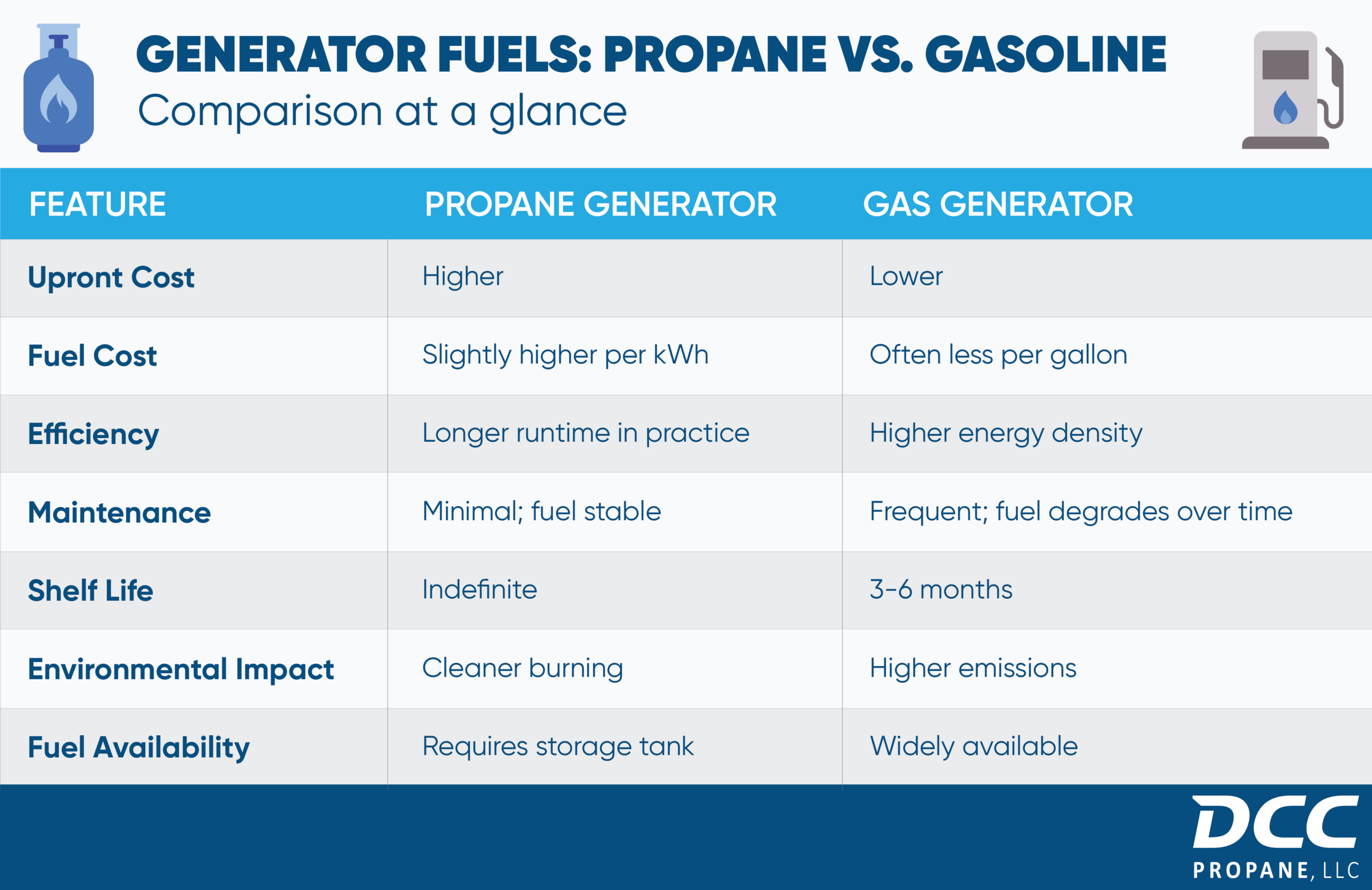
For many businesses, a dual-fuel generator offers the best of both worlds, switching between propane and gas depending on availability and cost.
The propane vs gas generator debate boils down to your priorities: cost, convenience, and sustainability. Gasoline wins on upfront affordability and energy density, while propane excels in maintenance, shelf life, and environmental impact. Whichever you choose, investing in a generator is about peace of mind – and that’s priceless.
To discuss propane generators and fuel supply, contact DCC Propane to talk with one of our energy experts.